
The Real Reason We Teach Robotics.
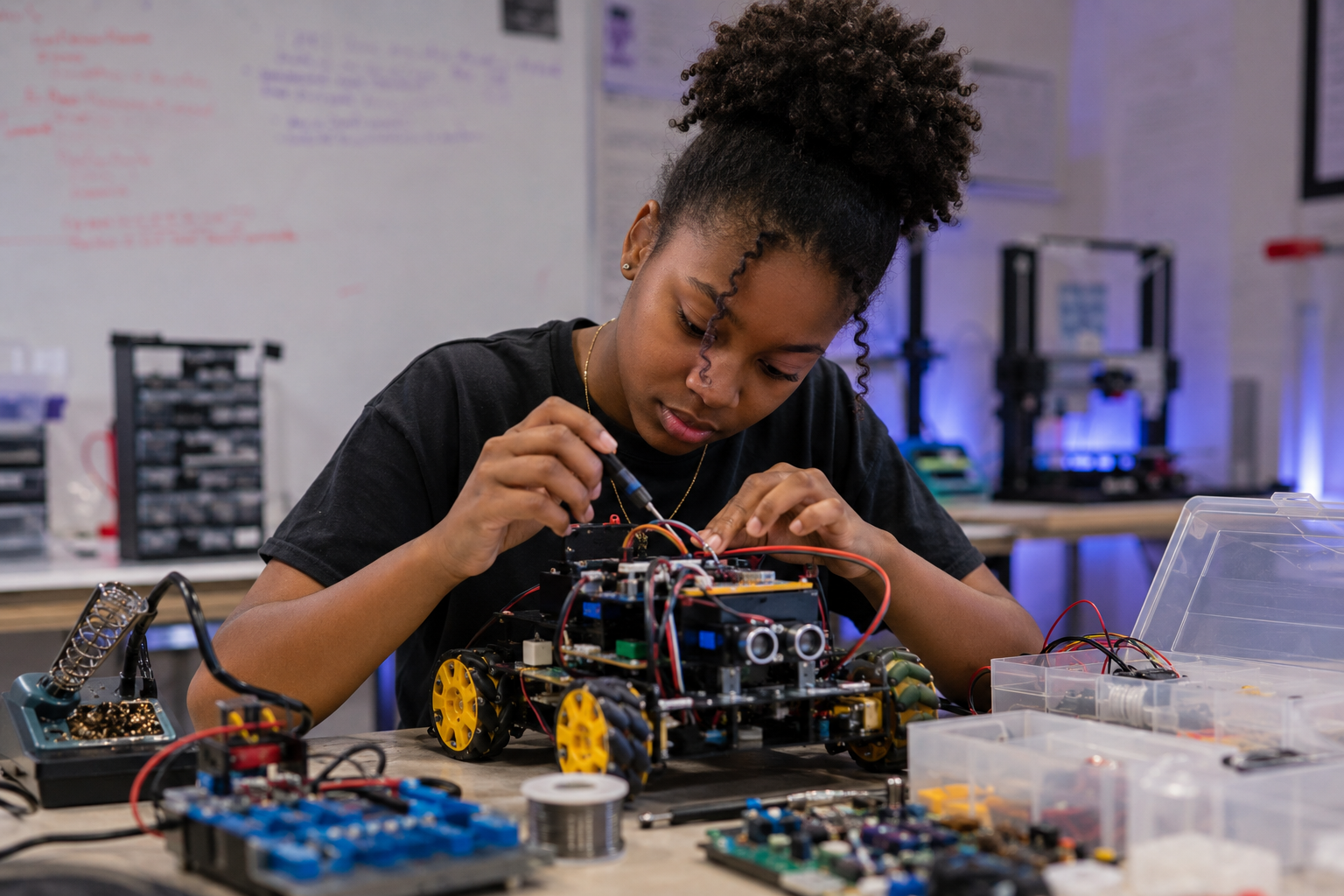
When many people hear the word “robotics,” they immediately think about wires, machines, coding, or futuristic technology. Some imagine expensive laboratories. Others think it is only for university students, engineers, or genius children who already know mathematics and science. But the real reason we teach robotics at Softmatic Academy has very little to do with robots alone.
We teach robotics because of what it does to the human mind.
A child may forget a formula taught in class. A teenager may forget the definition of voltage or resistance. But a student never forgets the moment they build something with their own hands and suddenly realize, “I can actually create things.”
That moment changes people, and that is the real beginning of engineering.
Across the world today, the biggest companies are no longer looking only for people who can memorise information. They are looking for people who can think independently, solve problems, communicate ideas, work in teams, and build practical solutions. According to the World Economic Forum, problem-solving, critical thinking, creativity, analytical reasoning, and technology literacy are among the most important skills shaping the future workforce. Robotics naturally develops all of them at once.
When a student builds a simple obstacle-avoiding robot, they are not just connecting wires. They are learning how systems work together. They begin to understand that every action has a cause, every output comes from an input, and every problem can be broken down into smaller parts and solved step by step. That mindset does not only help in engineering, but it also helps in life.
A person who learns robotics starts asking better questions.
“How does this sensor know there is an object?”
“Why did the motor stop moving?”
“What happens if I change this value?”
That curiosity is powerful because curiosity is the foundation of innovation. The countries leading the world in technology today did not become advanced because they had more people memorising textbooks. They became advanced because they raised generations of people who were encouraged to experiment, fail, test ideas, and build solutions.
That is why robotics education matters deeply, especially in Africa.
For many years, millions of students across developing countries have been trained mainly to pass examinations. But the world has changed. Employers now care about practical skills. Industries are becoming automated. Artificial intelligence is changing how businesses operate. Smart devices are everywhere. Cars, hospitals, farms, banks, factories, airports, and even homes now depend on embedded systems, automation, and intelligent technology.
The children growing up today will live in a world where understanding technology will no longer be optional.
They will either create technology or depend completely on technology created by others.
This is one of the reasons Softmatic Academy exists.
We do not see robotics as an extracurricular activity. We see it as a modern literacy. In the same way reading and writing became necessary skills during the industrial age, technology creation is becoming a necessary skill in the digital age.
But beyond the future of work, robotics changes confidence.
One of the most beautiful things happens when students who once believed technology was “too difficult” suddenly build their first working project. The quiet child in the corner becomes excited. The student who struggled academically suddenly becomes deeply engaged. The teenager who only consumed technology on social media starts thinking, “Maybe I can invent something too.”
This transformation is real.
Research from several STEM education studies has shown that hands-on learning significantly improves student engagement, creativity, retention, and confidence compared to passive classroom instruction alone. Students learn faster when they interact physically with concepts instead of only reading about them. When learners touch components, test sensors, debug errors, and physically see systems respond, learning becomes real instead of abstract.
That is why practical learning matters.
A student can read about automatic doors in a textbook for years and never truly understand them. But when they build one using an ultrasonic sensor and a servo motor, the concept becomes alive instantly. Suddenly, electronics is no longer “theory”, but now it becomes an experience.
At Softmatic Academy, we also teach robotics because it introduces students to failure in a healthy way.
For example; a robot may not work the first time.
A sensor may produce incorrect readings.
A motor may refuse to move.
A circuit may fail completely.
But instead of seeing failure as embarrassment, students begin to see it as feedback. They learn troubleshooting. They learn patience. They learn resilience. These are engineering habits, but they are also life habits.
Many successful founders, engineers, and innovators across the world developed their mindset through building things repeatedly, failing repeatedly, and improving repeatedly.
That process builds mental strength.
Robotics also naturally combines multiple fields together. A single project can expose students to electronics, programming, mathematics, design thinking, communication, teamwork, and artificial intelligence at the same time. This interdisciplinary learning is extremely important because real-world problems are not separated into school subjects.
For example, building a smart irrigation system for farming may require:
- sensors,
- coding,
- problem-solving,
- environmental awareness,
- data analysis,
- power systems,
- and design thinking.
This is how real innovation happens in the real world.
Another reason we teach robotics is because representation matters.
Many young Africans grow up consuming technology from other countries without ever imagining they can become inventors themselves. They use phones, apps, computers, and smart devices every day, but nobody shows them the engineering behind those systems.
The moment a student builds even a simple smart device, something changes psychologically. Technology stops feeling magical and starts feeling understandable. That understanding is empowering because people are less intimidated by what they understand.
This is especially important for younger students.
Children are naturally creative before society teaches them to fear mistakes. Robotics protects that creativity. It gives them a safe environment to imagine, experiment, and invent. One child may build a smart dustbin. Another may create a water-cleaning robot. Another may design an automated traffic system. These projects may begin as classroom activities, but the mindset behind them can grow into future companies, patents, startups, and industries.
Some of the world’s biggest innovations began as simple student experiments.
At Softmatic Academy, we believe the next generation of African innovators should not wait until university before touching real technology. Exposure matters early. Confidence grows early. Curiosity starts early.
And robotics is not only for children.
Adults, undergraduates, professionals, and career switchers are now realizing that technology skills are becoming valuable across almost every industry. Healthcare is becoming smarter. Agriculture is becoming automated. Manufacturing is becoming data-driven. Businesses are using AI systems. Logistics now depends on intelligent systems and automation. Even creative industries are changing because of technology.
Understanding how technology works is becoming one of the most practical skills anyone can have.
But perhaps the deepest reason we teach robotics is hope.
Every working project tells a young person:
“You are capable of solving problems.”
“You can build things.”
“You can think like an engineer.”
“You can create solutions people use.”
And sometimes, that belief changes an entire future.
That is why robotics education is not simply about teaching students how to build machines.
It is about teaching people how to believe they can build the future itself.